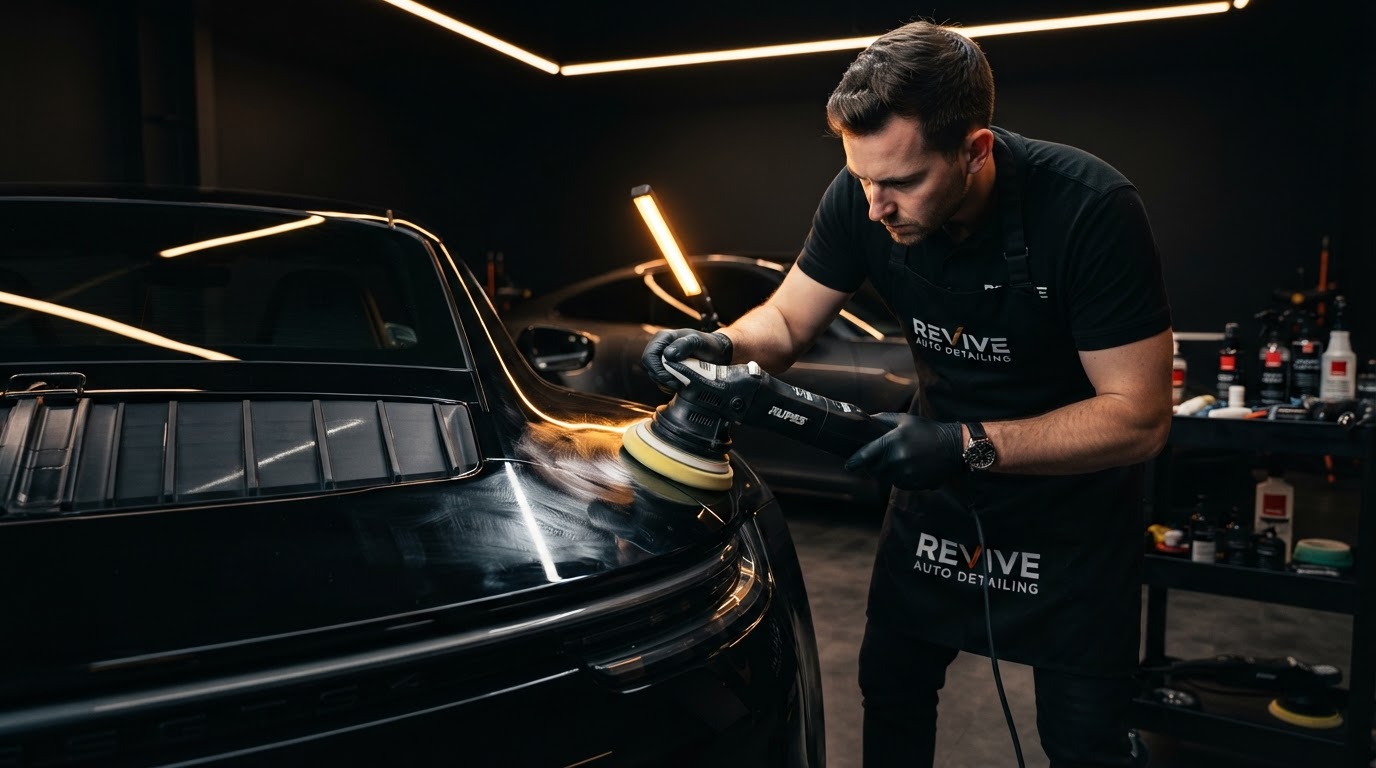
Swirl marks are those fine circular scratches you see most clearly in direct sun or under a streetlight at night. They're not in the color — they're in the clear coat, and almost every vehicle in South Carolina has them. Automated car washes, dirty towels, improper washing, and just plain time put them there. Paint correction is the process of leveling that clear coat to remove them.
How the damage forms
- Automatic car washes — the brushes grind the previous car's dirt across your paint
- Washing with a single bucket — grit gets dragged back across the panels
- South Carolina UV — oxidation dulls and chalks the clear coat over seasons
- Dry wiping — dusting a dry car with anything scratches the clear coat
The staged correction process
Real correction isn't one polish. We work in stages: a heavier cut to remove the deeper defects, then a refining polish to restore clarity and gloss. We measure clear coat thickness with a paint gauge before we start — there's only so much clear coat to work with, and we won't cut past what's safe. Lighting matters too; we inspect under directional LED lighting so we can see exactly what's left.
If someone quotes a 'one-step correction' for a car that's been through automatic washes for five years, they're not correcting — they're filling. The defects come back.
Why correction comes before coating
A ceramic coating is transparent. It locks in the paint exactly as it is. Correct first, then coat, and you get years of deep, defect-free gloss. Skip the correction and you've just sealed in the swirls. That's why every coating we install starts with an honest assessment of what the paint actually needs.
→ Read: Ceramic Coating in Spartanburg, SC — what it costs & why← Back to the Blue Horizon Detail homepage